On a sunny afternoon, within the campus of his Gurukula, Charaka gathers his disciples beneath the shade of a large Bilva tree. A gentle breeze stirs the leaves as he asks the attendants to bring forth the first patient.
Case 1: The merchant with severe constipation
A middle-aged merchant, pale and distressed, is brought in.
Attendant: He has not passed stool for over a week. His abdomen is bloated, and his mind is agitated. He is unable to sleep. His appetite and digestion were normal till recently, but now he eats very little and sleeps poorly.
Merchant (groaning): I have not passed stool for eight days. My belly feels full. I cannot eat. I cannot sleep. My mind is restless.
Charaka (after examination): His digestion appears normal, yet the waste does not move. The downward movement is arrested. Give him a moderate dose of Eranda Taila (castor oil) and apply warm fomentation over the lower abdomen and lower back. We will wait for some time to see if he passes stools.
(After a span of two muhurtas, the patient passes stool and relaxes visibly.)
Charaka (talking to students): You see the change. His digestive fire still burned, but the wastes, the stools, were trapped inside. Apāna Vāyu governs defecation, and when it is weak, waste accumulates, and distention ensues.
Case 2: The woman in prolonged and difficult labour
Charaka then ventures into the labour room where a young woman has been in labour for many hours. Her pains are strong but unproductive. The foetus does not descend. Her strength wanes.
Midwife: Her efforts are strong, but nothing progresses. The child does not descend.
Charaka (to students): The effort is present, but it has no direction. Begin gentle fomentation over her lower abdomen and lower back. Administer mild Anuvasana Vasti to restore the movement of Apāna.
(After treatment, the labour resumes and the baby is born safely.)
Charaka: Birth is not mere muscles in action. It is Apāna that gives direction to effort. When Apāna Vāyu is weak or erratic, the womb cannot expel the child. Muscles may strain without effect unless the force is guided in the right direction. Just as rivers need gravity to flow down to the ocean, so must the fetus be carried by Apāna downward to the world.
Case 3: The soldier with a history of fall during horse riding training
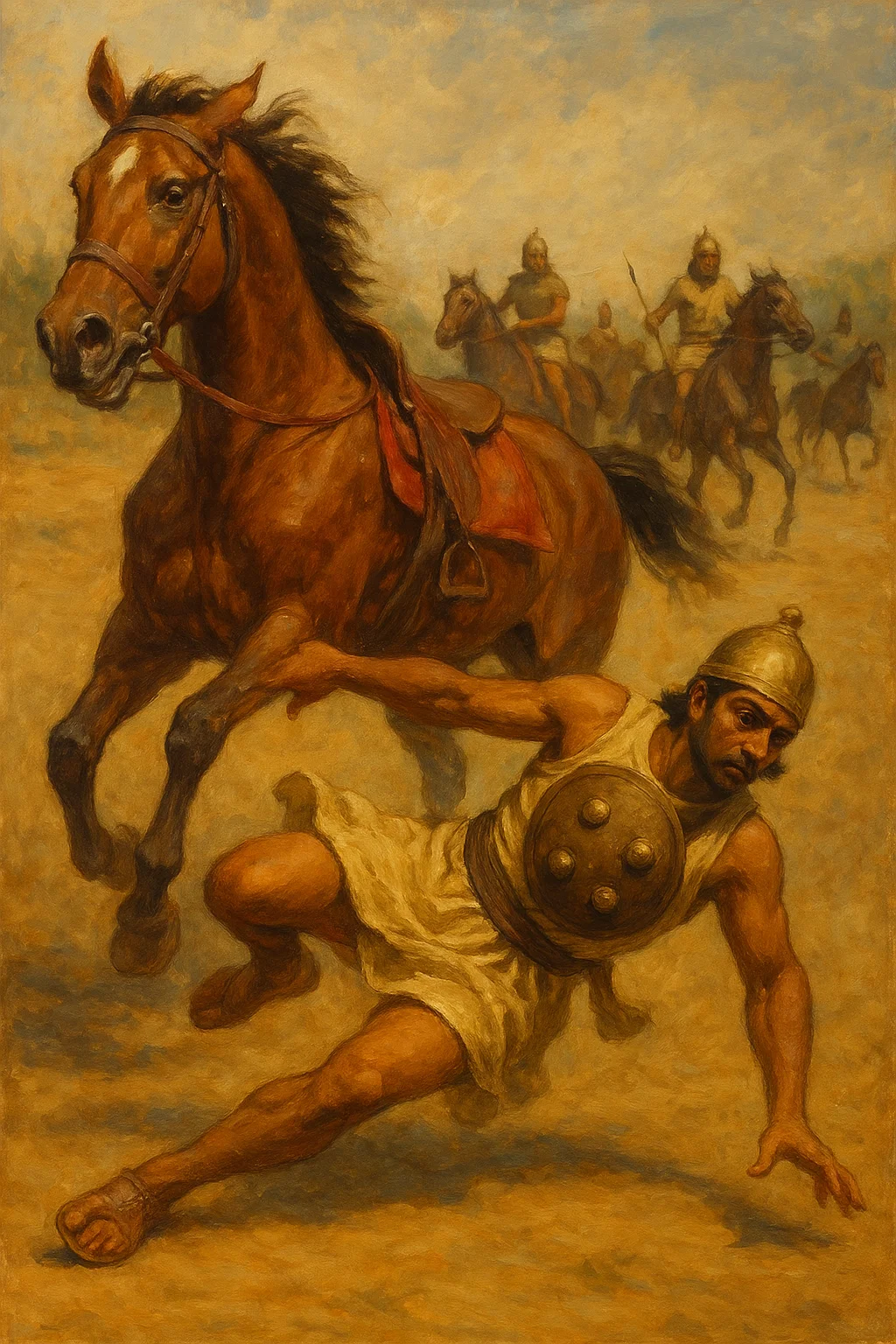
A young soldier who fell from his horse is lying on the bed in another room.
Attendant: Ācārya, this soldier fell during horse riding training. He has not passed urine or stools since last night.
Soldier (calm but anxious): I feel the painful distention, but no urge comes. My belly is tight.
Charaka (examining): There is no evident obstruction by stone, mass, or stricture. The injury lies in the spine, the Marma region. He cannot void because the command does not reach the organs.
Dhanvan: What causes these problems, Ācārya?
Charaka: This man’s channels are not blocked by any mass. The Apāna is malfunctioning because its root has been struck. The seat of Apāna lies in the pelvic region, and its strength arises from the spine. When that connection is disrupted, no signal reaches the bladder or the rectum.
Dhanvan: What needs to be done now?
Charaka: Lubricate the perineum. Prepare Uttara Vasti. Apply warm oil to the lumbar region.
(The procedure of Uttara Vasti is performed: a hollow metallic tube is gently inserted into the urinary bladder via the urethra, and a small amount of lukewarm medicated decoction is introduced. Shortly after, urine flows. A mild enema follows, and bowel movement resumes.)
Charaka: As Prāṇa draws in, Apāna expels out. One governs inhalation, swallowing, and life itself entering; the other governs defecation, urination, ejaculation, menstruation, and childbirth. These two Vāyus stand at opposite doors of the house of life. If either fails, the whole dwelling collapses.
######
Note: This is a work of fiction. No historical accuracy is claimed. The treatment methods described are entirely imagined and should not be attempted by patients.


Leave a Reply