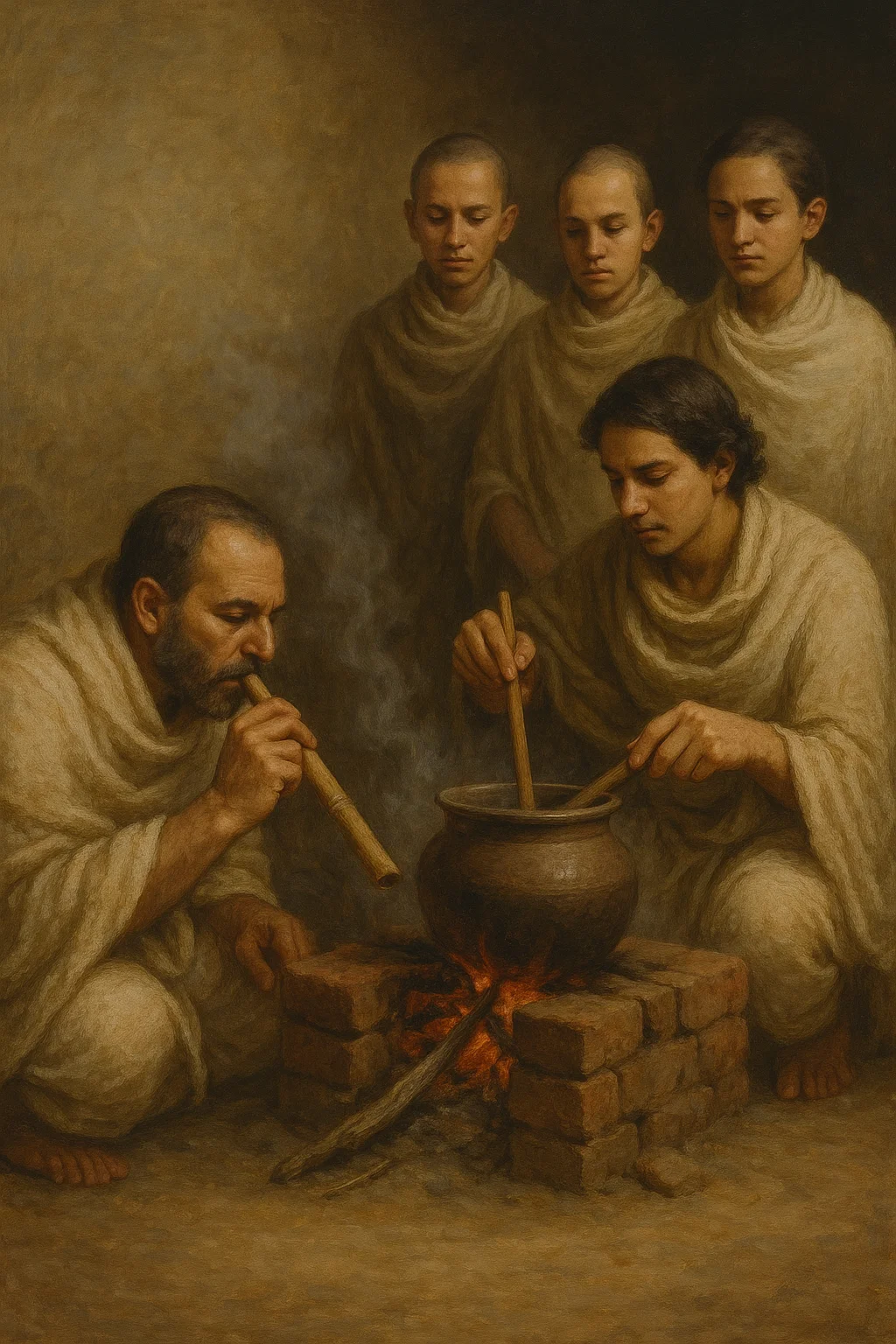
It is early spring. The forest Gurukula is quiet, the air scented with new blossoms. Morning coolness gives way to warmth by noon, and the rivers run fuller with melted snow. Charaka sits beneath a Bilva tree, his students gathered before him. They are still reflecting on the Vamana-karma (seasonally prescribed therapeutic vomiting) they underwent the previous day.
Charaka: This is Vasanta, the season of spring. Yesterday you experienced Vamana-karma, the therapeutic emesis. Please recall how it was administered.
Kumara: Master, first we were given sweet sugarcane juice to drink.
Bhargava: Then came a large quantity of decoction of the roots of licorice (Yaṣṭimadhu), warm, soothing, until the belly felt full.
Aaruni: And last, the paste of emetic nut (Madana-phala) was given to lick. That stirred the urge to vomit.
Charaka: Good. This is the proper order: first to line the stomach, then to fill it, and then to provoke the upward movement. Now, tell me why emesis (Vamana) is prescribed in spring, even for those who are healthy.
Kumara: Because Kapha aggravates in spring.
Aaruni: But Ācārya, this seems conflicting. Should not Kapha rise most in the rainy season, when the surroundings are damp and wet? Isn’t Kapha moist, wet, heavy?
Bhargava: Yes. Even I find it puzzling. Why should Vāta aggravate in the rainy season? Is not winter colder and drier, and thus more like Vāta?
Kumara: Yes. I too find this problematic. Why does Pitta rise in post-monsoon season, when the cold sets in, instead of in the burning, sultry summer months?
[The students look at one another, puzzled.]
Charaka (smiling): You have touched the heart of the matter. The predictions derived from the Tridoṣa theory are on the basis of the principle that “like increases like.” This is called Sāmānya–Viśeṣa doctrine. If your body loses fluids, you should drink more fluids. If your muscles weaken, you need to drink soups prepared out of meat. Similarly, in case of seasons, dampness should have increased Kapha, dryness should have increased Vāta, and heat should have increased Pitta.
Kumara: But then why are we taught something different?
Charaka: Well, when careful observations were recorded over many generations, the pattern was not so simple.
Aaruni: So when the theory based on “like increases like” does not match with what we see, does it stand falsified?
Charaka: Well, I would say yes. In spring we see more Tamaka-śvāsa patients, wheezing with phlegm; in the rains, more Vāta-vyādhi, the movement disorders; and in post-monsoon season, more cases of Amla-pitta with sour belching, burning, and even bleeding. When theory and observation clashed, our teachers held fast to observation. Thus the rules were corrected. That is how Āyurveda has endured: not by clinging to thought alone, but by shaping thought to the truth of experience.
Bhargava: So, when we ask “why Kapha rises in spring,” the answer is not hidden in dry logic but in what we see in the sick who come to us.
Charaka: Well spoken. That is why we say that in winter Kapha gets solidified, and in spring it liquefies because of exposure to the Sun. But this is an imaginative explanation invented to justify what is observed.
Aaruni: What I understand by this is that theories are not eternal truths. When we encounter counterexamples, we must modify our theories. Is my understanding correct?
Charaka: Yes, precisely. And to see deeply, you must begin within your own body. Vamana-karma could be a good teacher that provides you insights about how the body treats food.
Sequence of Vamana
Charaka: Yesterday you underwent Vamana. Tell me now, step by step, what you experienced.
Kumara: First there was profuse salivation, Praseka.
Bhargava: Then thick, clear mucus, Kapha.
Aaruni: After that, the large quantities of Yaṣṭimadhu decoction and sugarcane juice we had consumed came up.
Kumara: Then a sour liquid, burning as it rose.
Aaruni: And finally, a bitter yellow–green thick fluid with a sharp smell. It left the mouth bitter and pungent.
Charaka: You have observed well. Now, what does that yellow–green fluid remind you of? Do you see a somewhat similar colour elsewhere?
Kumara: Its colour is much like stool. But stool has a lighter tinge.
Charaka: Yes. But sometimes the stool turns white, as in some types of Kāmalā.
Kumara: You have told us about it. It is in obstructive Kāmalā. Then the stools are pale, even whitish. This suggests that the yellow–green fluid gives stool its colour. If its path is obstructed, it cannot enter the bowel, and then stool loses its tint.
Charaka: Yes. It is formed as a byproduct of Rakta, blood. We call it Accha Pitta, fluid Pitta. The fire inside this Pitta is not fluid. It is sharp and penetrating. It divides the food into useful and waste portions.
Kumara: So, does it help in digesting the meal?
Charaka: Perhaps yes. We can assume so. It seems to aid digestion before departing as waste. Just as red Masūra pulses lose their reddish hue and turn yellow when cooked, the food you eat changes its consistency and appearance when it undergoes digestion inside the body.
The Stages of Digestion
Charaka: What happens at the very beginning, before a morsel even enters the stomach?
Aaruni: At the sight or smell of food, the mouth waters.
Charaka: And that water is saliva. It moistens and makes the food pleasing. It helps in perceiving the taste. People with dry mouth find it difficult to perceive taste. We call this stage Madhura, pleasing.
Aaruni: Doesn’t Madhura stand for sweetness? Why are you calling it pleasing?
Charaka: Let me clarify. Something that pleases is called Madhura. Do not think only of sweetness on the tongue. We say, “What a sweet voice,” or “How sweet is one’s compassionate behaviour” though no sugar is in the sound or in behaviour. Madhura means agreeable, relishing, pleasing.
Bhargava: Thank you! It is clear now.
Aaruni: You told us that Prāṇa Vāyu is essential for swallowing. I think that too is important here.
Charaka: Yes, you are right. So the first stage of digestion is Madhura-avasthā. Food remains pleasing, softened, moist.
Kumara: As we experienced during Vamana-karma, profuse salivation happens first and then mucus comes out. Is this because the mucus is located at the upper part of the gut? In the Āmāśaya, the stomach?
Charaka: Yes, that is a correct assumption. That is why the first stage is marked by Kapha. And what follows next?
Bhargava: The sour liquid in the stomach. I think this is what causes sour belching and burning when we experience indigestion.
Charaka: Yes! And what principle governs sourness and sharpness?
Kumara: Pitta.
Charaka: Correct. The second stage is the Amla-avasthā, the sour stage. Here the food is further cooked by Pitta, just as the fire outside cooks rice. Without this inner fire, grain remains grain.
Aaruni: I think this is where you told us that Samāna Vāyu plays a role. To keep the food moving, churning, and helping the Agni burning.
Charaka: Good. You have grasped this well. And what comes after this fiery stage?
Bhargava: What remains after nourishment is drawn off: stool, urine, and gases.
Charaka: Exactly. But think of this: when sugarcane is pressed, the sweet juice flows out and the fibrous peel is cast aside. The juice is the sāra, the nourishing essence; the peel is the kiṭṭa, the waste.
Kumara: Like when we eat a mango, the pulp becomes strength to the body, but the seed and the peel are discarded?
Charaka: True. Then in the body too, from food arises rasa, which nourishes rakta, māṃsa, and the other dhātus, while the unusable part is expelled. This is the sāra–kiṭṭa vibhajana, the division of essence and residue. Without this essence, there could be no growth, no maintenance. All this takes place in the sour stage.
Aaruni: Then? After this stage?
Charaka: The final stage is marked by pungency, dryness, and expulsion. These are the qualities of Vāyu. The pungent gases that sometimes we expel mark the presence of Vāyu here.
Aaruni: And we know that Apāna Vāyu drives downward movement. This is the Kaṭu-avasthā, the pungent stage.
The Cooperation of Doṣas
Charaka: Now tell me: how many stages of digestion have we discussed?
Kumara: Three — Madhura, Amla, Kaṭu.
Charaka: And what drives the food through them?
Aaruni: Prāṇa Vāyu for swallowing, Samāna for mixing and aiding in the functioning of Agni, Apāna for expelling.
Bhargava: Pitta, the fire that transforms.
Kumara: Kapha, the moisture that helps us perceive taste, softens and lubricates.
Charaka: Each of you is correct. Digestion is not the work of one alone. Without Vāyu, food does not move; without Pitta, it does not transform; without Kapha, it does not soften. Have a look at the cook in our kitchen: the fire burns, the pot holds the water and the grains, the hand stirs, and the grain becomes edible. He often blows air to control the fire. If one fails, the meal fails.
Aaruni: Then Vāta, Pitta, and Kapha must be seen as co-workers, not rivals.
Charaka: Well said. Harmony gives health, imbalance gives disease.
Reflection from Experience
Bhargava: Ācārya, yesterday during Vamana I felt how the body itself follows this order. Saliva, mucus, sweet juices, sour liquid, yellow–green fluid — it was as if the body demonstrated how it treats food!
Charaka: Exactly. Vamana shows the body’s inner work in open sequence. That is why it is a teacher as much as a therapy.
Kumara: Then digestion is not a single act but a progression: pleasing, souring, pungent. If one stage falters, the whole chain is disturbed.
Charaka: That is your own understanding, drawn not from my words alone but from what you experienced. Hold it. For in Āyurveda, what we observe and test in the body is greater than what we imagine.
[The Bilva leaves shimmer in the spring breeze. The boys remain thoughtful, murmuring comparisons between their own experiences of Vamana and the stages of digestion. The lesson ends, but their curiosity carries forward.]
####


Leave a Reply