It is a warm afternoon in the courtyard of the Gurukula in Kashi. Sushruta sits beneath a banyan tree. His students gather around him, palm-leaf notebooks in hand. Two among them, Ketana and Ramana, sit closest, ever eager with questions.
Sushruta: Today you will not learn from books, but from people. (He gestures to his attendants.) Bring in the first patient.
Case 1: A Cook with Indigestion
[A middle-aged cook stands before Sushruta.]
Cook: Master, I can easily eat and digest rice, fruits, and vegetables. But whenever I take milk, curds, or cheese, my stomach churns. Soon after, I feel bloated, my belly makes noises, and loose stools follow, sometimes with cramping.
Sushruta: Are you disciplined with respect to eating?
Cook: Yes, Master. I eat in moderation, not too much nor too little, twice daily at fixed times. I rest after food, eat only when hungry, and do not indulge in excessive fasting. I eat while the food is still warm, avoiding meals too heavy, too light, too oily, or too dry. I do not argue or laugh while eating. I focus on the act of eating itself.
Sushruta (to Ketana): What do you make of this?
Ketana: He digests most foods well, but when he takes milk and milk products, his stomach rejects them. Yet if his digestion works for other foods, why do milk products trouble him so?
Sushruta: A keen question. There is movement, yes, but not proper transformation.
Ramana: Does it mean that Samāna Vāyu is functioning well? You told us it stirs the food, moves it near the inner flame, and it ensures that the flame burns neither too strong nor too dull.
Sushruta: Correct. The stirring is present, and the food moves. Yet when milk and curds enter, the flame does not act upon them. They resist digestion, and pass unchanged, with noise, pain, and loose stools.
Ramana: But why should the fire fail only for milk? If the fire were weak, would it not also fail with rice, fruits, and vegetables?
Sushruta: Most foods yield even to a modest flame. But in some, the ability to digest milk and curds is weak. It maybe because milk doesn’t suit everyone.
Ketana: Then is this simply a fault of Agni, or is there something lacking in the milk itself?
Sushruta: The fault lies with Pācaka Agni, though it varies from person to person. One may pass loose stools after a single cup of milk, while another remains constipated even after taking purgatives such as Trivrit. Each individual has a distinct power of digestion.
Ketana: What is the remedy in this case?
Sushruta: When Agni cannot act, milk remains unchanged. In such cases, avoidance is wise. But if the weakness is recent, it may be transient. Then herbs such as Trikatu may help kindle the inner flame.
[The cook is guided to reduce heavy milk and curds, to prefer lighter preparations such as buttermilk, and to take herbs such as Trikatu that strengthen the inner flame.]
Case 2: A Potter with Pallor
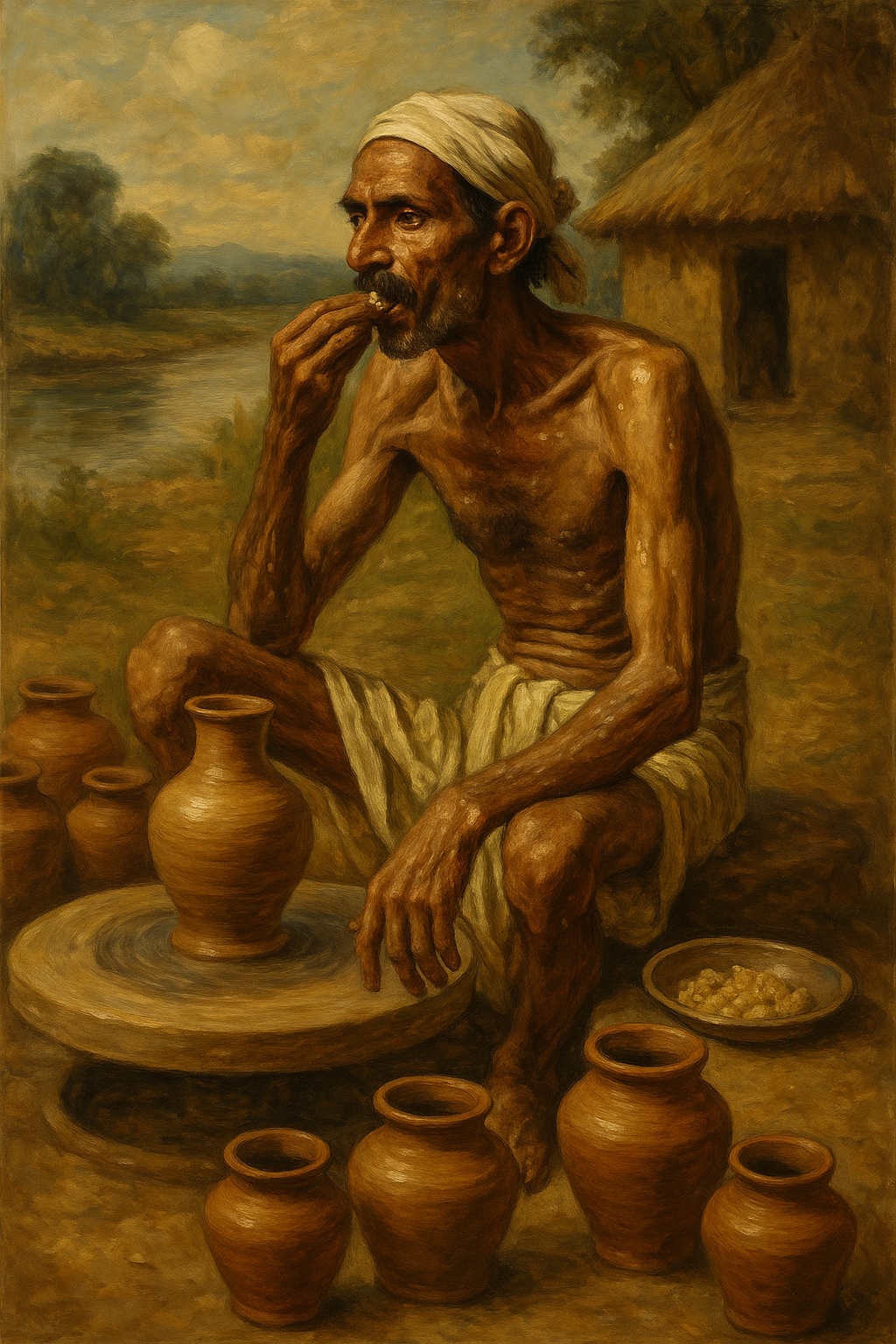
[A thin potter walks in. His lips and eyes are pale, his movements slow. He pauses often to catch his breath, leaning on his attendant.]
Potter: Master, I eat well, two full meals each day. My wife says I even eat more than my children. Yet I tire quickly. Even carrying clay to my wheel leaves me breathless. When I return from the riverbank, I must stop many times to rest.
Sushruta: You work daily with clay and earth by the river?
Potter: Yes. I dig mud, knead it with hands and feet, and spend hours shaping it. I love my work and often eat meals with mud still on my hands when in haste.
Sushruta: Do you pass anything unusual in your stools?
Potter: Yes. I often pass small white worms.
Sushruta: That could explain his weakness. His food is feeding the worms, not him. This is called Pāṇḍu, pallor, produced by eating mud.
[Sushruta takes a pinch of Mañjiṣṭhā powder and drops it into boiling water on the stove nearby. The clear water turns a deep red.]
Sushruta: See? The water is plain, but with this powder it takes on colour. So too in the body. Rasa, the essence formed after digestion, is clear. From it must emerge Rakta, rich and red. If this transformation is disturbed, say by worms consuming the essence, Rakta does not form. The body remains pale, no matter how much food is eaten.
Ramana: But the food we eat is not red. What gives blood its colour?
Sushruta: It is always fire that gives colour. The fiery sun reddens the horizon. Sunlight darkens the skin. Fire changes the colour and texture of pulses when cooked. As fire turns an iron ball red without changing its form, so Rañjaka Agni infuses otherwise clear Rasa with vibrant red.
Ramana: Where does Rañjaka Agni reside?
Sushruta: It resides in the liver and the spleen. If this fire weakens, Rakta remains unformed. Then the person becomes pale, breathless, and weak.
Ketana: And how do we know this?
Sushruta: When you open a goat or a deer, you will find that the liver is dark red, and the spleen darker still, both richer in blood than flesh or marrow. From this we assume that the fire which colours and strengthens blood must dwell there.
Ketana: In that case, does eating goat’s liver help a person recover from pallor?
Sushruta: Well said. Yes, I have seen pale patients regain blood after consuming goat’s liver. In others who suffered repeated bouts of fever, viṣama jvara, I observed an enlarged spleen, perhaps labouring to make up for deficient Rakta. This is the ground of my assumption, though I may be mistaken.
Ketana: So, we are guessing the cause based on what associations we observe, which might be wrong.
Sushruta: Yes, that is how hypotheses are generated using observations and associations. They are to be tested then.
Ramana: And what happens when Rañjaka Agni is extinguished?
Sushruta: Then no matter how much food is taken, strength does not return.
[The potter is given Vidanga paste to purge the worms. He is instructed to take bath after working with mud and before meals.]
Case 3: A Goldsmith with White Patches
[A goldsmith enters. His arms and neck show white patches, though the rest of his body looks normal.]
Goldsmith: Master, I work at the furnace each day, smelting and shaping metals. My strength is good, I eat well. Yet these marks spread slowly on my skin. They cause me no pain, but in the marketplace people stare.
Ramana: Master, why does his skin have white patches? What gives normal colour to the skin?
Sushruta: It is the fire that gives colour.
Ketana: Is that another form of Agni?
Sushruta: Yes. It is Bhrājaka Agni, the fire that dwells in the skin and gives it lustre. When it weakens, the skin loses colour.
Ramana: If the fire in the skin is weak, can it be kindled again?
Sushruta: Indeed. Just as damp wood responds to fire when exposed to the sun, so weakened Bhrājaka Agni may be ignited. For this we use Bakuchi (Psoralea corylifolia), both internally and externally. When its oil is applied and the skin exposed to sunlight, the patches often regain colour. All colours depend upon the sun’s radiance.
Ketana: So the sun itself assists the fire of the skin?
Sushruta: The sun is the great fire. What dwells within the body is but its reflection. By joining the herb with sunlight, the latent fire of the skin awakens, and complexion returns.
Case 4: A Weaver’s Son with Night Blindness
[A young boy, the son of a weaver, comes forward. His eyes look clear, yet he stumbles as the light dims.]
Weaver: Master, my son sees well in the day, but as sun sets, he loses his way. Indoors he cannot find the door or his bed without help.
[Sushruta lifts a small lamp nearby and lets its flame flicker low as the oil thins.]
Sushruta: You see this lamp? The wick is whole, yet when oil is scarce the flame grows faint. So too in the eye. The eyes are normal, but the flame within is weak.
Ketana: It seems the eye has lost its own fire.
Sushruta: Yes. This is Alochaka Agni, the fire of the eye. When it burns bright, the eye joins with outer light and vision is clear. When it dwindles, the world fades though the eye shows no wound.
Ketana: Then how may we strengthen it?
Sushruta: Fire is fed by fuel. To nourish Alochaka Agni, give him food rich in fire. Goat liver helps, just as it does in pallor, for it restores colour and vitality. In this way the inner flame steadies, and sight returns even as night falls.
Case 5: A Diffident Student with Lack of Confidence
[A young student stands hesitantly before Sushruta, his parents by his side. His shoulders are bent, his eyes lowered. He avoids looking at the other pupils.]
Father: Master, our son studies literature in a gurukula. But he has lost his confidence. He was sharp in the subject. He used to compose poetry in our native language, but now he struggles with Sanskrit. With special permission from his teachers he returned home for a short time, saying he could not keep pace with his companions. We bring him to you for guidance.
Student: Though I study each day, I cannot recite before others. My voice weakens and my memory fails me. The others seem swift and able, but I remain behind. Sometimes I feel I should leave the gurukula altogether and do farming.
Sushruta: Since when has this thought troubled you?
Student: From the time I went there. At home my family encouraged me. But in the new place everything felt strange, and the pupils were far ahead. I do not know Sanskrit well, and when I stumble, they sometimes laugh.
Sushruta (to Ketana): What do you see here?
Ketana: His body is strong. He eats well and shows no disease. Yet he lacks courage.
Sushruta: Correct. This is not a weakness of digestion, sight, or complexion, but of Sādhaka Agni, the fire that dwells in the heart and gives resolve, clarity of thought, and confidence.
Ketana: Fire again? Can the loss of confidence be spoken of in the same way as indigestion or pallor?
Sushruta: Yes. When it burns steadily, effort is turned into achievement. When it grows dim, even simple tasks seem heavy.
Ramana: But Master, why do you say it dwells in the heart and not in the head?
Sushruta: Because the heart stirs thought and emotion together. When one is anxious, does not the chest grow restless, the heart pound, and the pulse quicken? From this we assume that the fire of courage and determination resides there. The head gives thought, but the heart shapes it with energy. Yet remember, this too is an assumption that may be mistaken.
Ramana: Then how may his fire be strengthened?
Sushruta: First, what burdens him must be lifted. He struggles with the language, so his teachers must guide him patiently. His fellow pupils should not mock at him. His parents must encourage him gently. If the gurukula itself feels strange, he may be supported by a kind elder or companion until he feels at home.
Student (hesitantly): Would such kindness truly help me, Master?
Sushruta: Yes. Fire grows when sheltered from the wind. So too will your inner flame brighten when guarded from fear. Each dawn, sit quietly, breathe with steadiness, and recite a verse you know well. Begin with what is certain, then step by step move to what is new. Small victories feed the fire of confidence, until it shines without wavering. If you wish, I will even speak with your Guru, so that he may guide you with greater care.
[The student is encouraged to practice steady breathing at sunrise, to receive extra guidance in Sanskrit, and to find reassurance from his parents and elders.]
Ketana: Are these truly different fires, or one fire with many faces?
Sushruta: One fire. It digests, colours, illumines, steadies, and inspires. As the one sun shines in many waters, so Agni takes distinct forms in different places.
Ramana: And when these fires are disturbed, disease follows?
Sushruta: Yes. Pallor, white patches on the skin, impaired digestion, poor sight, confusion—all are signs of Agni gone astray. But remember this: each of these five Agnis dwells in its own Pitta—Pācaka, Rañjaka, Bhrājaka, Alochaka, and Sādhaka. It is through Pitta that Agni works.
[The afternoon shadows lengthen. A breeze stirs the banyan leaves. The students sit in silence, their palm-leaf notes filled, their minds illumined by the theory of the Five Fires.]
#####


Leave a Reply